Research
Computation, data science and AI for energy materials.
We use computation, data science and AI to understand and design materials for energy and sustainability. Our current work follows three directions: solid-state ionics for batteries, porous materials for carbon capture and gas separation, and AI-driven multiscale modelling. The publication graph shows how our papers connect these themes.
Solid-state ionics and battery materials
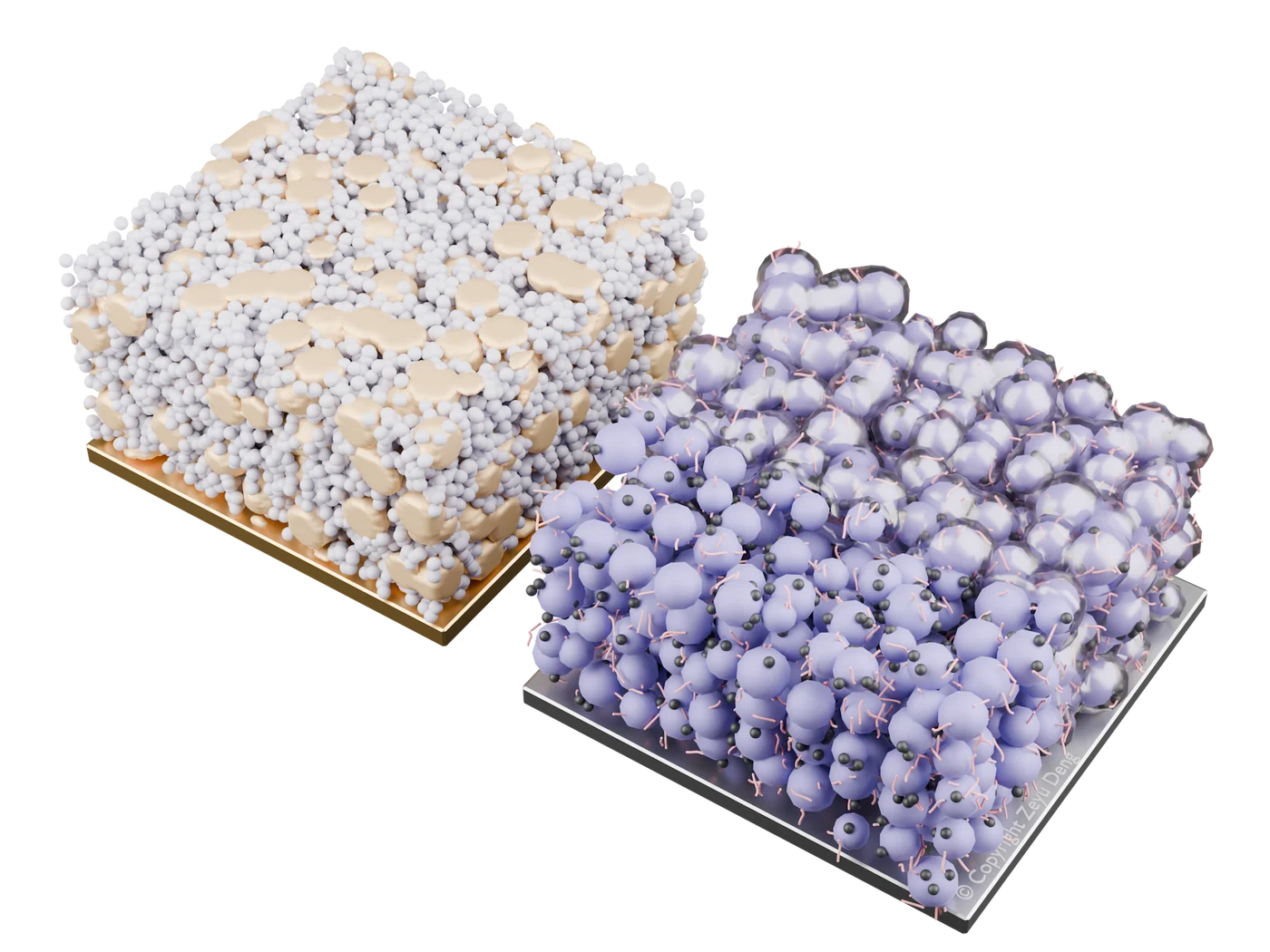
All-solid-state batteries replace the flammable liquid electrolyte with a solid fast-ion conductor, which can improve the safety and energy density of lithium- and sodium-based cells. We study what controls ion transport and stability in these materials, from the bulk to grain boundaries, coatings and interfaces. Recent work covers the aqueous stability of lithium halide and oxyhalide electrolytes, the effects of grain boundaries and surfaces on the electronic and mechanical properties of solid electrolytes, and sodium-ion transport in NaSICON. We combine density functional theory with cluster expansion, Monte Carlo and kinetic Monte Carlo sampling, machine-learning interatomic potentials, and phase-field modelling of dendrite growth.
Selected papers:
- Design Principles for Aqueous Stability of Lithium Halide and Oxyhalide Solid Electrolytes from First-Principles Pourbaix Analysis. Li and Deng, ACS Energy Lett. (2026).
- Accelerating the discovery of disordered multi-component solid-state electrolytes using machine learning interatomic potentials. Deng et al., J. Mater. Chem. A (2025).
- Effects of Grain Boundaries and Surfaces on Electronic and Mechanical Properties of Solid Electrolytes. Xie et al., Adv. Energy Mater. (2024).
- Kinetic Monte Carlo Simulations of Sodium Ion Transport in NaSICON Electrodes. Wang et al., ACS Mater. Lett. (2023).
People: Shoutong Jin, Yan Li, Naibing Wu and Cheng Peng (team). See all battery papers.
Porous materials for carbon capture and gas separation
Aluminium formate, Al(HCOO)3 (ALF), is a low-cost porous metal formate with a ReO3-type framework. With experimental collaborators, we study how its hydrogen-confined pore cavities recognise CO2 over hydrocarbons, how temperature-regulated gating enables gas separations, and how hydrophobic composites and related metal formates improve CO2 capture. ALF has also been evaluated for noncryogenic air separation and hydrogen storage. Our calculations address adsorption sites, binding energies and adsorption kinetics.
Selected papers:
- Hydrophobic Metal–Formate Composites for Efficient CO2 Capture. Das et al., J. Am. Chem. Soc. (2025).
- Temperature-Regulated Gating Enables Gas Separations in Ultramicroporous Aluminum Formate, ALF. Evans et al., Chem. Mater. (2025).
- Precursor-Modulated Synthesis Enables a Stable and Activatable Mn(III) Formate With the ReO3-Type Topology. Das et al., Small (2026).
- Exclusive Recognition of CO2 from Hydrocarbons by Aluminum Formate with Hydrogen-Confined Pore Cavities. Zhang et al., J. Am. Chem. Soc. (2023).
People: Fuzhi Li (Jason) (team). See all ALF papers.
AI and multiscale modelling
The performance of a battery or a sorbent emerges across length and time scales, from electrons and atoms to devices. We develop methods that carry information between these scales: machine-learning interatomic potentials that reach the size and time scales of disordered materials, descriptors of local atomic environments such as luMOD, machine-learning models of thermodynamic stability, and AI-assisted workflows that link first-principles calculations to mesoscale and continuum models.
Selected papers:
- AI-Organized Multiscale Battery Modeling: Linking Structure and Property from Quantum to Device Scales. Jin et al., Small Struct. (2026).
- luMOD: A Lightweight Universal Midrange Atomic Orientational Descriptor. Deng et al., J. Chem. Theory Comput. (2025).
- Predicting thermodynamic stability of inorganic compounds using ensemble machine learning based on electron configuration. Zou et al., Nat. Commun. (2025).
People: Tzu-Chen Liu, Yanhao Deng and Jingyuan Lin (team). See all machine learning papers.
Software

- kMCpy is an open-source Python package for computing ion transport in solids with kinetic Monte Carlo (paper, tutorial).
- atombatch batches energy and force evaluations from many independent ASE tasks into shared model calls.
- Wendao turns course notes into an interactive knowledge graph with a course-grounded AI tutor. It also powers our publication graph.
More code is on our GitHub.
Hybrid halide perovskites and optical materials
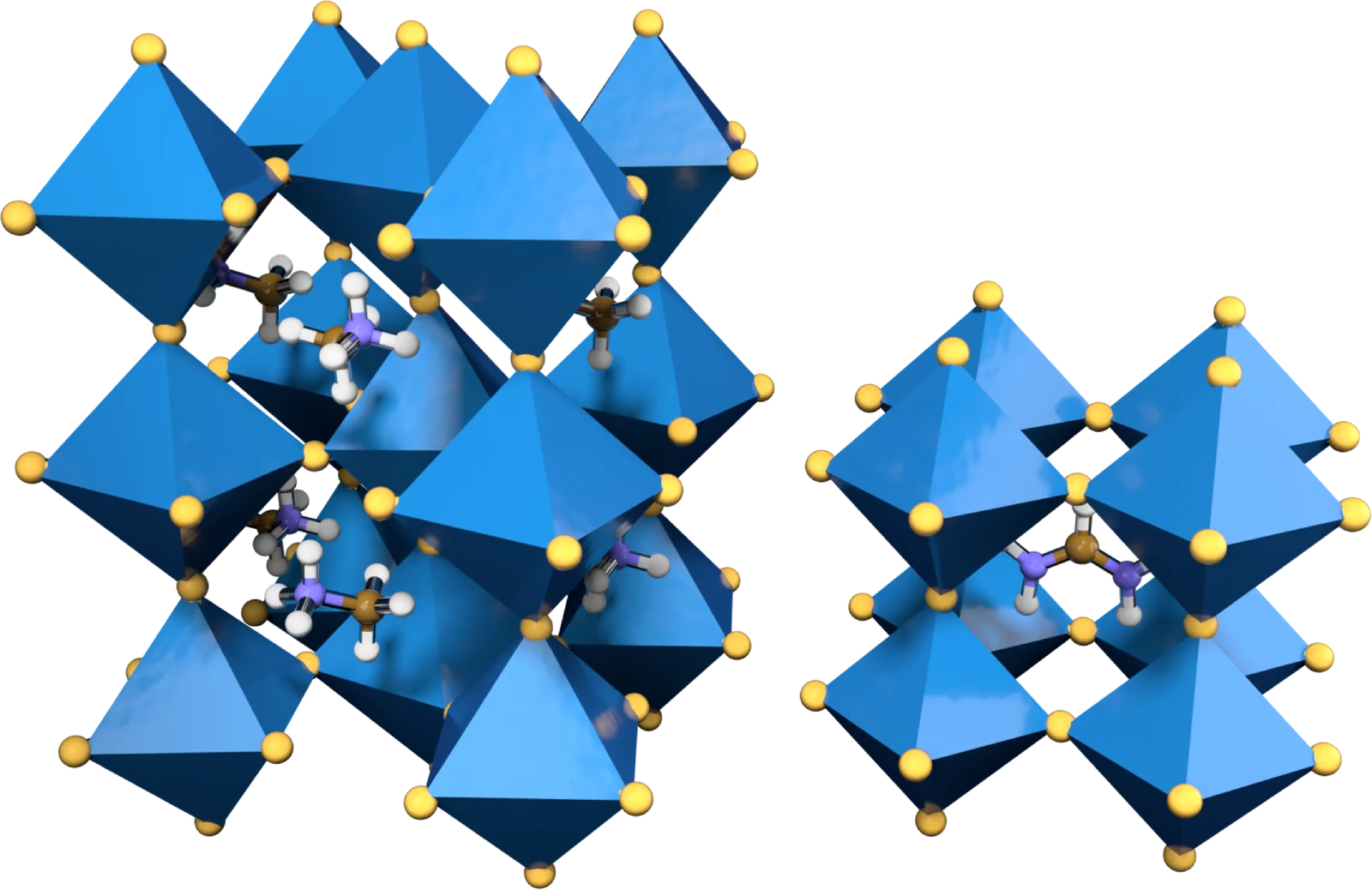
Our earlier work on hybrid halide perovskites focused on the discovery of lead-free compositions through the double perovskite approach. With experimental collaborators, we continue to study low-dimensional hybrid halides and germanium perovskite ferroelectrics for light emission and nonlinear optics.
Selected papers:
- High-Performance Second-Harmonic Generation in Hybrid Ge Perovskite Ferroelectrics Enabled by Confinement Engineering. Guo et al., Aggregate (2026).
- Topochemical photocycloaddition in two-dimensional lead-halide coordination polymers with tunable phosphorescence. Chen et al., Chem. Sci. (2025).
See all perovskite papers.